
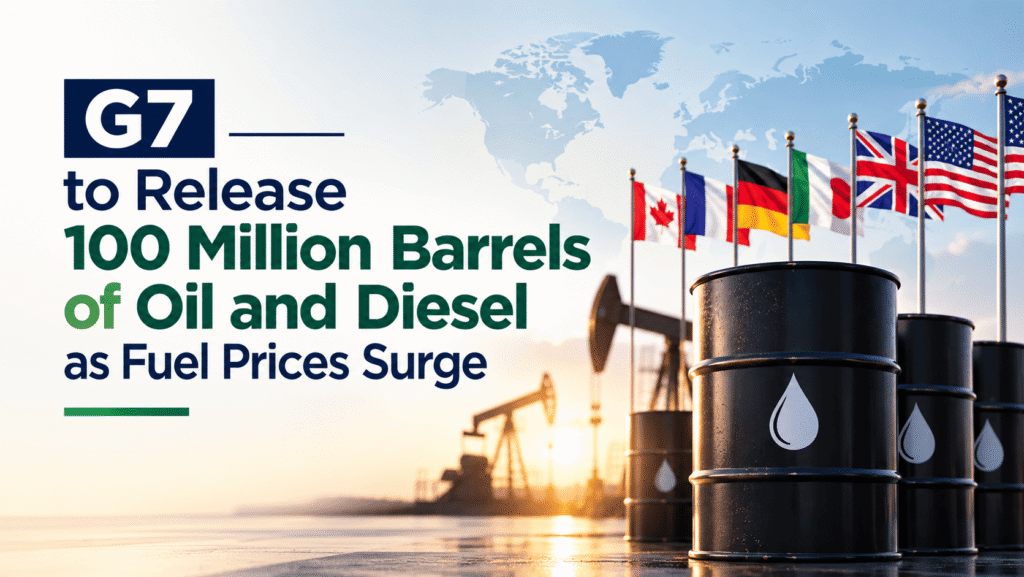

The Group of Seven (G7) nations have agreed to release 100 million barrels of crude oil and fuel products from emergency reserves to ease pressure on global energy markets.
The coordinated release will begin immediately and run for four months through the International Energy Agency (IEA).
A substantial volume of diesel will be released within the first 20 days. The move comes as fuel prices rise sharply amid disruptions to global oil supplies and growing concerns over energy security.
The agreement followed a virtual meeting of G7 leaders on October 2, 2026. French President Emmanuel Macron convened the meeting as governments sought coordinated measures to address escalating energy prices.
G7 targets diesel shortages with emergency oil release
According to the G7 leaders’ statement, the 100 million barrels will be released through a coordinated mechanism involving the IEA.
The statement did not indicate that all 100 million barrels would consist of diesel. Instead, it provides for a broader release of emergency energy stocks, with a substantial portion of diesel front-loaded into the first 20 days.
The G7 also agreed to consider additional diesel releases if market conditions require further intervention.
The IEA has been asked to monitor the implementation and impact of the programme. It will also provide a follow-up report within 20 days, including recommendations on future responses and replenishment of emergency stocks.
Why the G7 is releasing 100 million barrels
The decision comes against a backdrop of significant volatility in global oil and refined-product markets.
Diesel prices have risen sharply in the United States and Europe as geopolitical disruptions have affected crude production, refining operations and shipping routes.
The disruptions have also increased concerns about the availability of refined petroleum products.
Reuters reported that the United States had pressured European countries to release emergency diesel inventories. The pressure came amid discussions over a possible US restriction on diesel exports.
The G7 agreement also includes a commitment to avoid energy export restrictions between member countries.
The leaders called on other oil-producing countries to avoid measures that could further tighten global supplies.
G7 seeks to protect global energy markets
Beyond releasing emergency reserves, the G7 agreed on additional measures aimed at increasing refined-product availability.
The group plans to coordinate maintenance schedules at its refineries. This is intended to reduce the risk of several major facilities shutting down simultaneously.
The G7 will also encourage countries with significant refining capacity to increase production where possible, particularly for diesel.
These measures are designed to complement the emergency stock release rather than rely solely on reserve withdrawals.
The group also called for the restoration of navigational rights in the Strait of Hormuz, a major route for international energy shipments.
Disruptions around the waterway have added to uncertainty over global oil and fuel supplies.
Oil prices respond to the announcement
Global oil prices moved lower following news of the coordinated reserve release.
Brent crude was reported trading around $100.80 per barrel after falling by about 1.48%. West Texas Intermediate also declined, trading around $90.40 per barrel.
The market reaction reflects expectations that additional supplies could ease some of the immediate pressure on crude and refined-product markets.
However, the size of the price response will depend on how quickly the reserves enter the market and whether supply disruptions continue.
Emergency stock releases can provide short-term additional supply. They do not, by themselves, resolve longer-term production, refining or transportation constraints.
US and Europe face pressure over diesel supplies
Diesel has become a particular concern because it is heavily used by trucks, agricultural equipment, industrial machinery and other commercial activities.
Europe also relies significantly on imported diesel supplies.
Reuters reported that the United States had warned that failure to increase European emergency stock releases could lead to consideration of restrictions on US diesel exports. Such a move could have further tightened supplies in Europe.
The latest G7 agreement includes a commitment by members to refrain from energy export restrictions.
The decision therefore addresses both sides of the immediate supply problem: releasing additional stocks and maintaining the flow of energy products between partner countries.
What the G7 oil release could mean for consumers
The immediate objective is to increase market liquidity and reduce supply pressure.
If additional diesel and crude reach the market quickly, wholesale prices could come under downward pressure.
However, the effect on retail fuel prices will vary across countries.
Retail prices also depend on taxes, transportation costs, refining margins, exchange rates and local distribution costs.
Therefore, a decline in international crude prices does not necessarily translate into an equivalent reduction in pump prices.
Possible implications for Nigeria
Nigeria, as a major crude oil producer and a large petroleum-products market, could also be affected by developments in international oil prices.
Lower international crude prices could put pressure on government oil revenues and the value of crude exports if the decline becomes sustained.
At the same time, lower global prices for refined petroleum products could benefit markets that rely on imported or internationally priced fuel.
The overall impact on Nigeria would therefore depend on the duration and scale of the price movement, domestic production, refining activity and exchange-rate conditions.
Nigeria’s growing domestic refining capacity could also change how global fuel-market movements are transmitted to local consumers.
G7 says further action remains possible
The G7 has not ruled out additional intervention.
Its statement says members will meet within the IEA framework in the coming days to discuss whether further diesel releases are necessary.
The group also said it would continue monitoring developments and adjust its measures if required.
For now, the 100-million-barrel release represents a coordinated effort to add emergency supplies during a period of elevated energy-market volatility.
The effectiveness of the measure will depend largely on how quickly the reserves reach consumers and whether underlying disruptions to crude production, refining and transportation ease.