
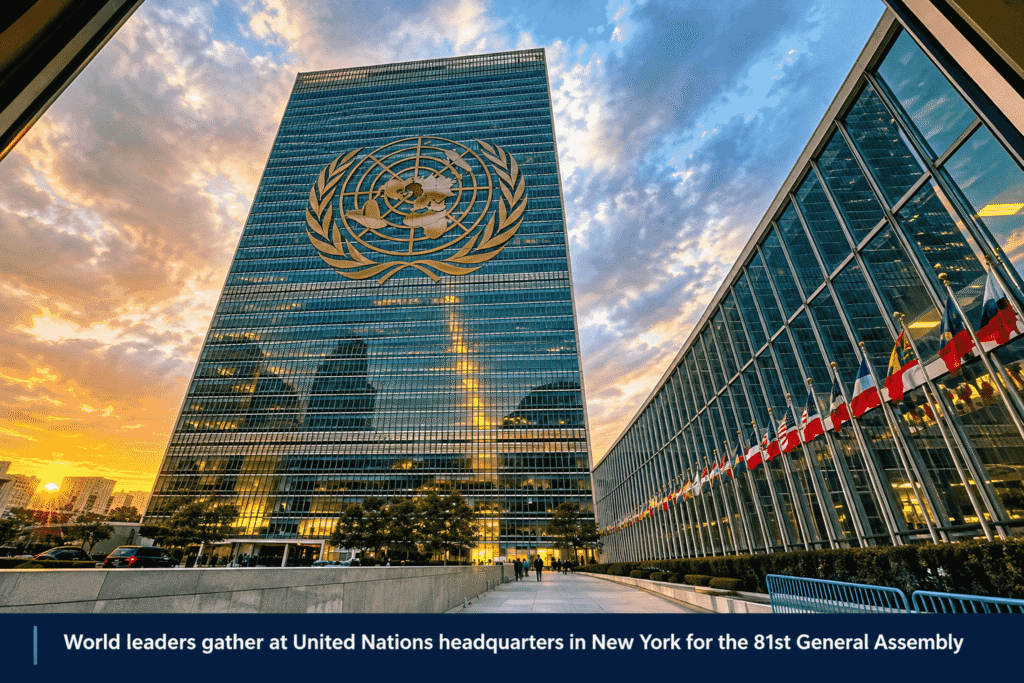

World leaders are gathering in New York for the 81st United Nations General Assembly, with diplomacy, global conflicts, artificial intelligence, climate change and development expected to dominate discussions.
The high-level General Debate begins on Tuesday, September 22, 2026, bringing heads of state, government leaders and senior representatives to the UN headquarters. The debate will continue through September 26 and resume on September 28.
The meeting comes at a time of deep international divisions. Conflicts in the Middle East and Ukraine remain major diplomatic concerns, while governments are also grappling with climate pressures, economic challenges and the rapid development of artificial intelligence.
Against this backdrop, the UN has placed the idea of rebuilding trust and strengthening international cooperation at the centre of this year’s gathering.
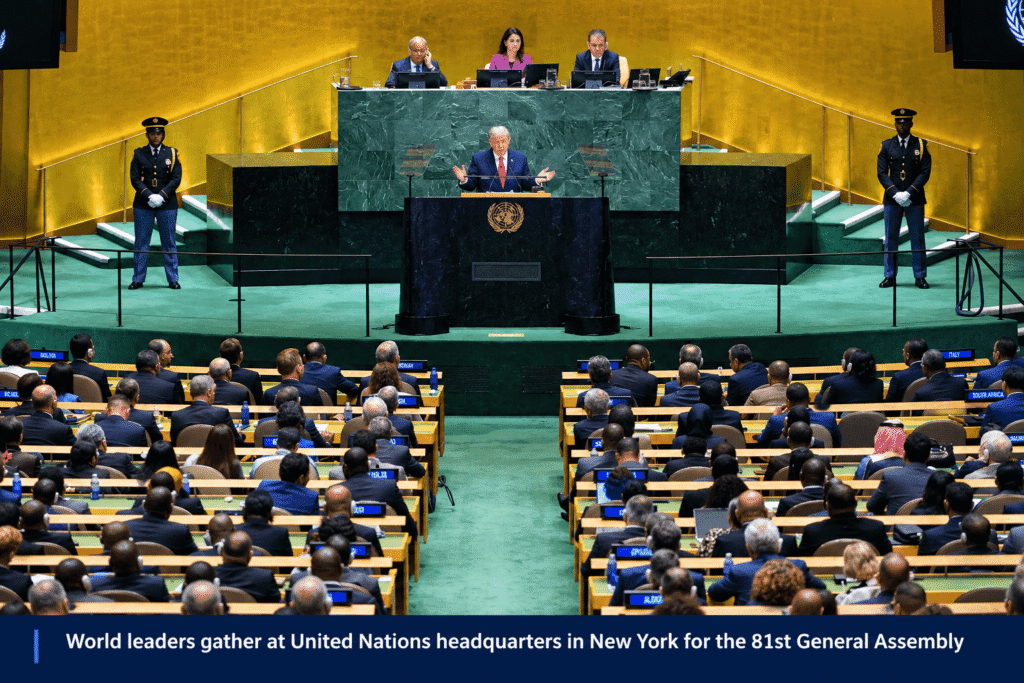
UN General Assembly focuses on restoring trust
The official theme for the 81st session is “Restoring Trust, Managing Transformation: A United Nations That Delivers for All.”
The theme reflects concerns about the ability of multilateral institutions to coordinate responses to problems that cross national borders.
UN Secretary-General António Guterres has repeatedly called for stronger international cooperation on global challenges. The UN’s programme for the high-level week similarly emphasises collective action for peace, dignity, equality and sustainable development.
The General Assembly provides an unusual diplomatic setting because countries with sharply different interests are represented in the same forum.
That makes the annual debate both a platform for competing national positions and an opportunity for governments to identify areas where cooperation remains possible.
Conflicts will dominate the diplomatic agenda
The wars involving Iran and Ukraine are expected to feature prominently during the high-level discussions.
Reuters reported that US President Donald Trump is scheduled for a series of meetings with international leaders during the General Assembly, with the conflicts in Iran and Ukraine among the issues on the agenda.
Iran has also indicated that it sees the UN gathering as an opportunity for diplomacy.
A senior Iranian official said Tehran was prepared to discuss reopening the Strait of Hormuz under conditions involving a reduction in US military pressure and an end to the blockade of Iranian ports. Iranian officials have also said their delegation in New York has authority to pursue negotiations.
Meanwhile, Ukrainian President Volodymyr Zelenskyy has said he and Trump agreed to meet in New York during the General Assembly.
Zelenskyy said peace remains Ukraine’s priority and pointed to discussions around de-escalation, security, energy and food security.
The meetings do not guarantee agreements. However, the presence of key leaders creates opportunities for direct discussions that may be more difficult to arrange elsewhere.
UN president calls for common ground
The search for areas of agreement is also central to the agenda of the General Assembly’s president, Bangladesh’s Khalilur Rahman.
Rahman, who presides over the 81st session, has made rebuilding trust and consensus major elements of his programme.
In his acceptance speech after being elected, he said he would seek common ground without ignoring differences. He also committed to engaging member states and creating space for good-faith negotiations.
That approach acknowledges a basic reality of international diplomacy.
Countries do not have to agree on every issue to cooperate on matters where their interests overlap.
For the General Assembly president, the challenge is therefore to create opportunities for negotiation despite disagreements over security, trade, development and international governance.
Artificial intelligence becomes a global policy issue
Artificial intelligence is another major issue expected to receive attention during the UN meetings.
The technology has moved rapidly from a specialist subject into areas involving national security, economic competitiveness, public services and employment.
Governments are increasingly debating how advanced AI systems should be developed and governed.
Reuters reported that AI is emerging as a central issue at this year’s UN gathering, with calls for greater international coordination and common standards.
The United Kingdom is also expected to announce a new AI defence partnership with the United States during Prime Minister Andy Burnham’s first appearance at the General Assembly.
The proposed cooperation is focused on trusted and interoperable AI technologies for national security and critical infrastructure.
The broader challenge for governments is finding a balance between technological innovation and measures intended to manage potential risks.
Climate change remains high on the agenda
Climate change will also feature prominently during the high-level week.
The UN has scheduled a high-level meeting on climate action and the just transition, bringing together leaders from major economies, developing countries, vulnerable nations and energy-producing and consuming states.
A separate high-level meeting on sea-level rise is scheduled for September 24.
The UN says the meeting will examine measures to protect lives and livelihoods, preserve development gains and strengthen international responses to rising sea levels. Particular attention will be given to small island developing states and low-lying coastal communities.
For developing countries, climate discussions are closely linked to financing, infrastructure and economic development.
This means negotiations are likely to extend beyond environmental targets to questions about how countries can finance adaptation and protect vulnerable communities.
Africa’s priorities will also come into focus
African countries traditionally use the General Assembly to highlight issues including development financing, debt, climate change, peace and security, reform of international institutions and greater representation in global decision-making.
The continent’s governments also have an interest in discussions around technology, trade and investment.
For African states, international cooperation is particularly relevant because many of the challenges facing the continent require resources and partnerships that extend beyond national borders.
Issues such as energy access, food security, infrastructure, climate resilience and digital transformation are connected to broader global economic policies.
The General Assembly therefore provides African leaders with an international platform to place these priorities before a wide diplomatic audience.
The future of the UN will be part of the conversation
The gathering also comes during an important period for the United Nations itself.
Secretary-General António Guterres’ term ends on December 31, 2026, meaning the process of selecting his successor is among the significant institutional issues surrounding this year’s session. Reuters identified the succession process as one of the issues likely to attract attention during the General Assembly.
The leadership transition comes as the organisation faces questions about its ability to respond effectively to conflicts and global crises.
The broader debate is therefore not only about individual disputes. It also concerns how the multilateral system can function when major powers disagree on fundamental issues.
A difficult test for international cooperation
The 81st General Assembly presents world leaders with a crowded diplomatic agenda.
From wars and humanitarian crises to climate change and artificial intelligence, many of the issues under discussion cannot be addressed by individual countries acting alone.
Yet the same international divisions that make cooperation necessary can also make agreements difficult.
The General Assembly offers a forum where those differences can be openly expressed while leaving room for negotiations behind closed doors.
Whether leaders can turn that diplomatic space into concrete agreements will depend on their willingness to identify areas of shared interest.
For the UN’s 81st session, the stated objective is clear: restore trust, manage rapid global transformation and strengthen cooperation.
The coming days in New York will show how much common ground governments can find amid their competing national interests.