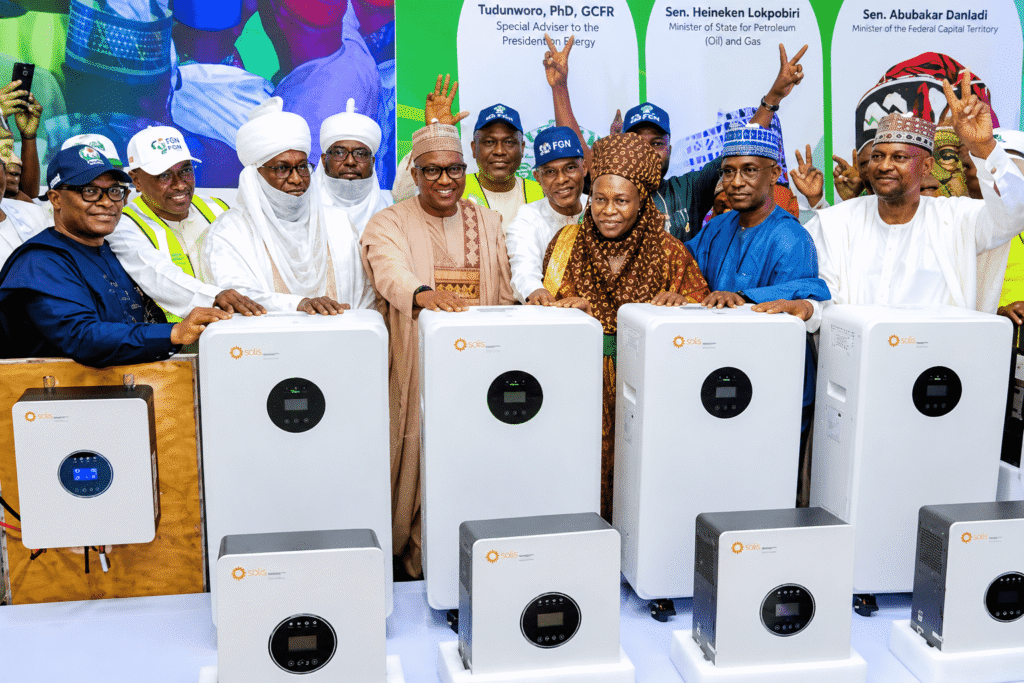

The Speaker of the House of Representatives, Rt. Hon. Tajudeen Abbas, has flagged off solar power installations for hospitals, schools, security posts and other public facilities across the Zaria Federal Constituency of Kaduna State.
The intervention was unveiled during a series of constituency project activities in Zaria over the weekend. The programme also included the commissioning of a 110 kVA solar installation at the Kongo Campus of Ahmadu Bello University (ABU).
Beyond the solar project, Abbas also performed groundbreaking ceremonies for an International Conference Hall for the Zaria Education Development Association (ZEDA), a modern skills acquisition centre and office accommodation for the National Directorate of Employment (NDE).
The projects are focused on electricity supply, education, vocational training and access to employment-related services within the constituency.
Solar power extended to schools and hospitals
The solar installations are intended to provide an alternative source of electricity for essential public facilities.
According to Abbas, the systems will be deployed to locations including health facilities, schools and security posts, as well as mosques and churches.
He explained that reliable electricity is particularly important in facilities where services cannot simply stop when conventional power fails.
At healthcare centres, for example, electricity supports activities ranging from patient treatment to the operation of essential equipment. In schools, electricity can support teaching, learning and other administrative activities.
The Speaker said the intervention was designed around these practical needs.
“A hospital cannot pause treatment when the lights go out. A student cannot stop an examination and wait for power,” Abbas said at the event.
The project therefore represents an attempt to address electricity challenges through decentralised renewable energy systems.
ABU Kongo receives 110 kVA solar installation
One of the major components of the intervention is the 110 kVA solar installation commissioned at the ABU Kongo Campus.
The facility is expected to provide additional power for activities at the university campus.
Speaking about the project, Abbas said steady electricity would help staff perform their duties and enable students to study under more reliable conditions.
The intervention comes against the background of the high electricity costs faced by tertiary institutions.
At the commissioning ceremony, the Vice-Chancellor of Ahmadu Bello University, Professor Adamu Ahmed, reportedly said the university spends about ₦300 million monthly on electricity bills. He added that the solar intervention could reduce the institution’s electricity expenditure by about one-third.
If sustained, the use of solar power could therefore have implications beyond electricity availability, particularly in reducing dependence on conventional power sources and generators.
Local youths trained to maintain solar systems
An important component of the project is the training of young people from Zaria to install and maintain the solar systems.
Abbas said the approach was intended to create local technical capacity rather than relying entirely on external contractors for future maintenance.
“Panels need care. Batteries need checking. Faults need fixing,” the Speaker said.
He added that training local youths to handle the systems could help extend their useful life while giving beneficiaries practical technical skills.
The approach also creates a link between infrastructure development and youth employment.
Instead of treating the solar equipment solely as an infrastructure project, the programme incorporates training that could allow some beneficiaries to develop skills in renewable-energy installation and maintenance.
New facilities planned for education and skills development
The solar intervention was unveiled alongside other constituency projects.
One of them is the ZEDA International Conference Hall, which is expected to provide additional space for academic, educational and community activities.
Abbas described the project as a facility for teachers, scholars and community organisations.
Another major project is the modern skills acquisition centre.
The centre is intended to provide young people with vocational and practical training that can potentially support employment and self-employment.
Abbas said the objective should go beyond providing training, arguing that skills development should ultimately enable beneficiaries to earn a living.
“I want young women and men to leave that centre able to solve a problem, serve a customer, and earn an honest wage,” he said.
The projects therefore combine physical infrastructure with skills development and employment-related initiatives.
NDE office accommodation included in projects
The Speaker also performed the groundbreaking for office accommodation for the National Directorate of Employment.
The project is intended to bring Federal Government employment services closer to residents of the constituency.
The NDE is responsible for implementing employment-related programmes, including initiatives targeting skills development and job creation.
According to Abbas, the office is part of a broader effort to make government services more accessible within Zaria.
The combination of the NDE facility with the skills acquisition centre also creates the potential for a connection between training and employment services.
Renewable energy becomes part of constituency development
The Zaria intervention reflects the growing use of solar energy to address electricity challenges in public institutions.
Nigeria continues to face difficulties with reliable electricity supply, making alternative energy sources increasingly relevant for schools, hospitals, government facilities and businesses.
Solar systems can provide power independently of the national grid, although their effectiveness depends on factors including system design, battery capacity, maintenance and the quality of installation.
For the Zaria projects, the decision to train local residents to maintain the systems could become an important factor in determining their long-term sustainability.
The projects also demonstrate how renewable energy can be combined with other constituency interventions rather than treated as a standalone infrastructure programme.
Abbas links projects to wider development plans
Speaking during the event, Abbas said the projects were part of his efforts to attract investment and development initiatives to Zaria Federal Constituency.
He also credited the administration of President Bola Ahmed Tinubu with supporting some of the initiatives.
The Speaker described the projects as part of a broader approach linking infrastructure with education, healthcare, employment and community development.
However, the actual long-term impact of the projects will depend on their completion, effective operation and maintenance.
For the solar installations in particular, sustained performance will require proper management of batteries, panels, inverters and other components.
What the Zaria projects mean for residents
The projects cover several areas that directly affect public services.
The solar installations are aimed at improving electricity access for healthcare facilities, schools and security locations. The ABU Kongo installation provides a specific institutional application of the renewable-energy programme.
Meanwhile, the ZEDA conference hall is intended to provide additional educational and community space, while the skills acquisition centre focuses on vocational training.
The planned NDE office is designed to improve access to Federal Government employment services.
Taken together, the projects represent a constituency development package built around electricity, education, skills and employment.
The extent to which these interventions translate into lasting improvements will ultimately depend on implementation and continued maintenance.
For Zaria residents, the immediate focus will therefore be on the completion of the ongoing projects and whether the new facilities deliver the services for which they were established.