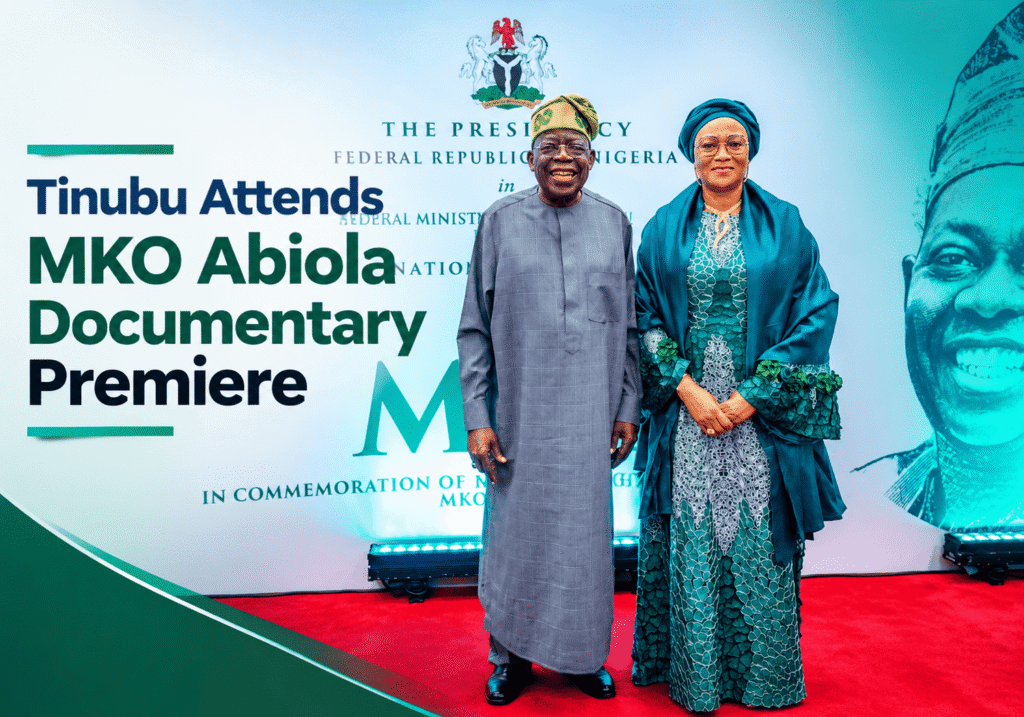

President Bola Ahmed Tinubu and First Lady Oluremi Tinubu attended the national premiere of MKO, a documentary chronicling the life, political struggle and legacy of late Chief Moshood Kashimawo Olawale Abiola.
The premiere was held on Thursday, October 1, 2026, at the Wole Soyinka Centre for Culture and Creative Arts in Iganmu, Lagos. The event formed part of activities marking Nigeria’s 66th Independence Anniversary.
The documentary was produced and directed by Nigerian-American filmmaker Ose Oyamendan. It focuses on Abiola’s political journey, the June 12, 1993 presidential election, its annulment and the pro-democracy struggle that followed.
Tinubu, dignitaries attend MKO premiere
President Tinubu served as Chief Host of the national premiere. He attended alongside the First Lady and several senior government officials and political leaders.
Those present included Senate President Godswill Akpabio, Speaker of the House of Representatives Tajudeen Abbas, Lagos State Governor Babajide Sanwo-Olu and Ogun State Governor Dapo Abiodun.
Other dignitaries included Kwara State Governor AbdulRahman AbdulRazaq, Plateau State Governor Caleb Mutfwang, Deputy Senate President Jibrin Barau and Deputy Speaker Benjamin Kalu.
Chief of Staff to the President Femi Gbajabiamila, Minister of Art, Culture, Tourism and the Creative Economy Hannatu Musawa and former Ogun State Governor Olusegun Osoba also attended the event.
Documentary revisits June 12 struggle
MKO examines the events surrounding the June 12, 1993 presidential election, which was annulled by Nigeria’s military government.
The election and its aftermath became a major episode in Nigeria’s political history. The annulment triggered sustained resistance from pro-democracy activists and other Nigerians demanding recognition of the electoral mandate.
The documentary also covers Abiola’s subsequent detention and death in custody in 1998.
According to the State House, the film seeks to preserve the history of the struggle and the sacrifices made by Nigerians who opposed military rule.
The Minister of Art, Culture, Tourism and the Creative Economy, Hannatu Musawa, described the documentary as an effort to document stories surrounding June 12 for future generations.
She said the film honours those who sacrificed their lives during the struggle for the June 12 mandate and the democratic system Nigeria has today.
Ose Oyamendan highlights Abiola’s political legacy
Speaking at the premiere, filmmaker Ose Oyamendan paid tribute to the people who participated in the pro-democracy struggle.
Oyamendan also acknowledged President Tinubu’s involvement in the events surrounding the struggle against military rule.
The filmmaker recalled interviewing Tinubu when he was a senator in 1992. He also drew from his own experience as a journalist with Weekend Concord, a newspaper founded by Abiola.
The documentary features archival footage and accounts from several prominent figures connected to the period.
They include former military Head of State Ibrahim Babangida, former Head of State Abdulsalami Abubakar, former President Olusegun Obasanjo and Nobel laureate Wole Soyinka.
Abiola’s running mate in the 1993 election, Baba Gana Kingibe, also features in the film. Other participants include former United States ambassador to Nigeria Walter Carrington and members of the Abiola family.
MKO documentary opens in Nigerian cinemas
The 108-minute documentary had its international premiere at the Sheffield International Documentary Festival in the United Kingdom on June 12, 2026.
Following its national premiere in Lagos on October 1, the film began its scheduled commercial cinema run across Nigeria on October 2.
Nile Entertainment is handling the film’s Nigerian theatrical distribution.
The timing of the national premiere also links the documentary to Nigeria’s Independence Day celebrations.
By revisiting Abiola’s political journey and the June 12 struggle, the film brings a major chapter of Nigeria’s democratic history to a contemporary audience.
For younger Nigerians who did not experience the political crisis of the 1990s, the documentary provides an opportunity to examine the events, personalities and struggles that preceded the country’s return to democratic rule in 1999.
Preserving Nigeria’s democratic history
The national premiere brought together political leaders, government officials, filmmakers and personalities connected to Nigeria’s political history.
The State House said the documentary is expected to contribute to preserving the country’s democratic history and keeping the experiences of the June 12 period accessible to younger generations.
The story of MKO Abiola remains closely associated with June 12 and Nigeria’s transition from military rule to the Fourth Republic.
The documentary therefore provides a historical account of Abiola’s life while examining the wider pro-democracy movement that emerged after the annulment of the 1993 election.