

Nigeria’s electricity debate may be entering a different phase as the Federal Government shifts attention from power generation to reliable electricity delivery.
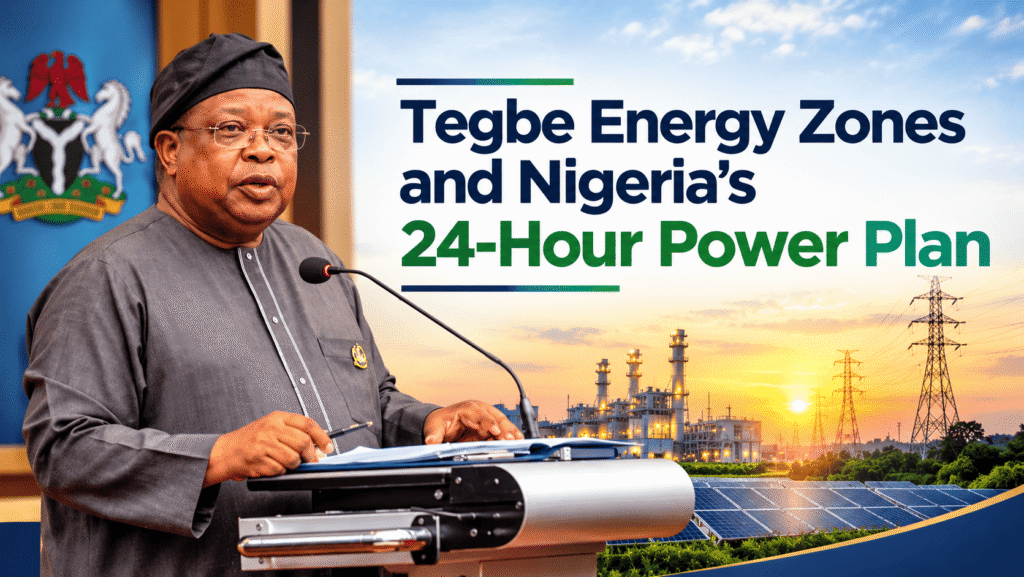
The Minister of Power, Joseph Tegbe, is leading plans to establish dedicated Energy Zones in major economic corridors.
The proposed zones are designed to provide stable, 24-hour electricity to homes, businesses and industries in high-demand areas.
The initial corridors are the Lagos axis, Abuja-Kaduna-Kano corridor and Enugu-Port Harcourt corridor. The Federal Government is working with selected electricity distribution companies on the proposal.
At its core, the initiative reflects a simple reality. Generating electricity is only one part of Nigeria’s power problem.
Electricity must also be transmitted, received by distribution companies and delivered efficiently to consumers.
That final stage is where the Energy Zones proposal places significant emphasis.
Nigeria’s power challenge goes beyond generation
For years, discussions around Nigeria’s electricity sector have focused heavily on megawatts.
Attention has centred on generation capacity, transmission infrastructure and the performance of power plants.
Those issues remain important. However, Tegbe has argued that the sector’s constraints also include the ability of distribution companies to take up available electricity and deliver it to end users.
The minister made the point during a strategic meeting with selected DisCos on the proposed Energy Zones.
This distinction matters because electricity has little economic value if it cannot reach the businesses and households that need it.
A power plant can generate electricity. Transmission lines can carry it. Yet inadequate distribution infrastructure can still prevent consumers from receiving dependable supply.
The proposed approach therefore places greater emphasis on the connection between electricity supply and economic activity.
Why the three Energy Zone corridors matter
The choice of the three initial corridors is also economically significant.
The Lagos axis contains one of Nigeria’s largest concentrations of commercial, industrial and residential electricity demand.
The Abuja-Kaduna-Kano corridor links the Federal Capital Territory with major commercial and industrial centres in northern Nigeria.
Meanwhile, the Enugu-Port Harcourt corridor connects important economic centres across the South-East and South-South.
The government’s stated objective is to strengthen infrastructure in these high-demand areas so that electricity supply can keep pace with demand as economic activity expands.
In other words, the zones are being conceived around areas where reliable electricity could have substantial commercial consequences.
From megawatts to money
The most important aspect of the proposal may be its economic logic.
Nigeria’s electricity challenge is often measured by how much power is generated. Yet businesses experience the crisis through its financial consequences.
When electricity supply is unreliable, manufacturers often rely on diesel-powered generators.
Small businesses also spend money on alternative power sources. Offices invest in inverters and generators. Hospitals require backup systems. Cold-chain businesses face additional operating risks.
These costs eventually affect prices, investment decisions and employment.
Reliable electricity could therefore change the economics of production.
A factory that can depend on grid electricity for most of its operations can reduce its reliance on diesel. A business can plan its working hours more confidently. An industrial cluster can potentially increase production without adding the same level of expenditure on self-generation.
This is where the phrase “from megawatts to money” becomes relevant.
The economic test of Nigeria’s electricity reforms should not only be how much electricity is generated. It should also consider what consumers and businesses can produce with the electricity delivered to them.
Energy Zones could improve DisCo revenues
The proposal also has a commercial dimension for distribution companies.
The Federal Government says the Energy Zones are intended to unlock commercial and industrial demand while strengthening DisCo revenues and collections.
That creates an important link between reliability and revenue.
Where electricity supply is poor, customers have stronger incentives to depend on alternative sources.
However, if DisCos can provide predictable electricity and improve service delivery, electricity consumption could become more commercially valuable.
Better service could also make customers more willing to pay for electricity that they can actually depend on.
The model therefore seeks to connect infrastructure investment with improved electricity consumption, revenue collection and economic activity.
Why 24-hour power will require more than a government announcement
The Energy Zones remain a proposal at this stage.
The government has announced the target corridors and begun discussions with selected electricity companies. However, the available public information does not yet provide a detailed implementation timetable, specific capacity targets or the full investment requirements for achieving continuous supply.
That distinction is important.
A 24-hour electricity zone requires more than additional generation.
It requires adequate transmission capacity, functioning transformers, strong feeders, sufficient distribution infrastructure, effective metering and reliable maintenance.
It also requires enough generation to meet demand when customers are consuming power.
Any weak point in that chain can undermine the entire objective.
The role of DisCos will be critical
The participation of DisCos is particularly important because the initiative focuses heavily on the distribution end of the electricity market.
The meeting with government included representatives of Abuja Electricity Distribution Company, Ikeja Electric, Eko Power, Ibadan Electricity Distribution Company and Sahara Energy Group.
Their role will extend beyond simply receiving electricity from the grid.
Distribution infrastructure must be capable of handling the expected demand within each zone.
The companies will also need to improve operational efficiency, reduce losses and ensure that available electricity reaches paying customers.
This makes the Energy Zones as much a distribution reform proposal as an electricity-supply initiative.
The business case for reliable electricity
For Nigerian businesses, the value of reliable electricity can extend beyond lower generator costs.
Predictable electricity can improve production planning.
It can reduce downtime.
It can support longer operating hours.
It can make investments in machinery more commercially viable.
It can also influence where companies choose to locate factories, warehouses and other facilities.
For investors, reliable infrastructure is part of the calculation when assessing operating costs.
Consequently, successful Energy Zones could potentially become economic clusters where electricity availability supports manufacturing, commerce and services.
That possibility explains why the initiative is broader than a promise to keep the lights on.
But the benefits must extend beyond selected corridors
A major policy question will be how successful Energy Zones are eventually expanded.
Concentrating investment in areas with strong commercial demand can have an economic rationale. Yet Nigeria’s electricity needs extend far beyond Lagos, Abuja, Kano, Enugu and Port Harcourt.
If the Energy Zones succeed, the government will face the challenge of translating lessons from the initial corridors into a broader national electricity strategy.
The zones should therefore be viewed as potential starting points rather than a replacement for wider power-sector reform.
Nigeria still needs improvements across generation, transmission and distribution.
Measuring success beyond megawatts
The eventual performance of the Energy Zones should be assessed using practical economic indicators.
These could include electricity availability, outage frequency, distribution losses, collection efficiency and customer satisfaction.
They could also include changes in diesel consumption, industrial output, business expansion and employment.
Such measurements would provide a clearer picture of whether reliable electricity is translating into economic value.
A zone that supplies electricity for longer hours but fails to support productive activity would tell only part of the story.
The bigger objective should be to create an environment where dependable electricity allows businesses and households to plan with greater certainty.
A different way to think about Nigeria’s electricity problem
Tegbe’s Energy Zones proposal introduces an important shift in emphasis.
Instead of treating electricity solely as a question of how many megawatts Nigeria can generate, the approach focuses attention on where electricity is needed and whether the infrastructure exists to deliver it.
That does not eliminate Nigeria’s generation and transmission challenges.
Rather, it recognises that additional generation will have limited economic impact if distribution networks cannot effectively deliver the power.
The success of the Energy Zones will ultimately depend on implementation.
For now, the three proposed corridors represent an attempt to connect reliable electricity with the parts of the economy capable of using it productively.
The real measure will not simply be the number of megawatts delivered.
It will be what Nigerians are able to produce, invest, employ and build when dependable electricity becomes available.
That is where the shift from megawatts to money becomes meaningful.