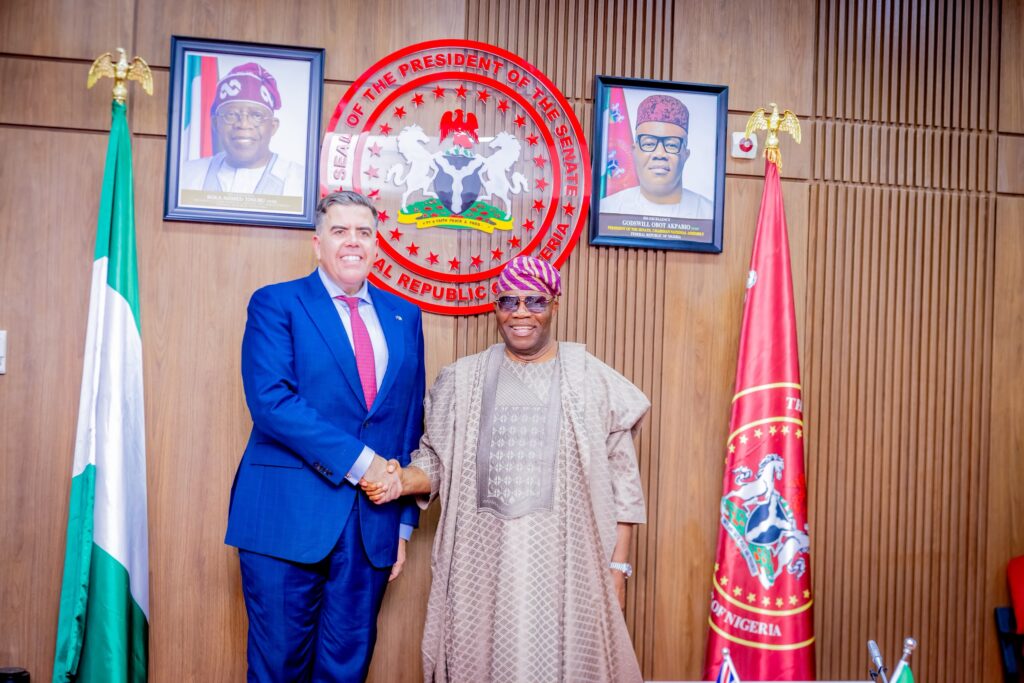

Senate President Godswill Akpabio has pledged Nigeria’s support for Milton Dick, Speaker of the Australian House of Representatives, in his bid to become President of the Inter-Parliamentary Union (IPU).
Akpabio made the commitment when Dick visited the National Assembly in Abuja on September 28, 2026, to seek Nigeria’s support ahead of the forthcoming IPU presidential election.
The meeting also focused on strengthening parliamentary and bilateral relations between Nigeria and Australia.
Akpabio said Nigeria attaches importance to the IPU as a platform for parliamentary dialogue, democratic development, peace and international cooperation.
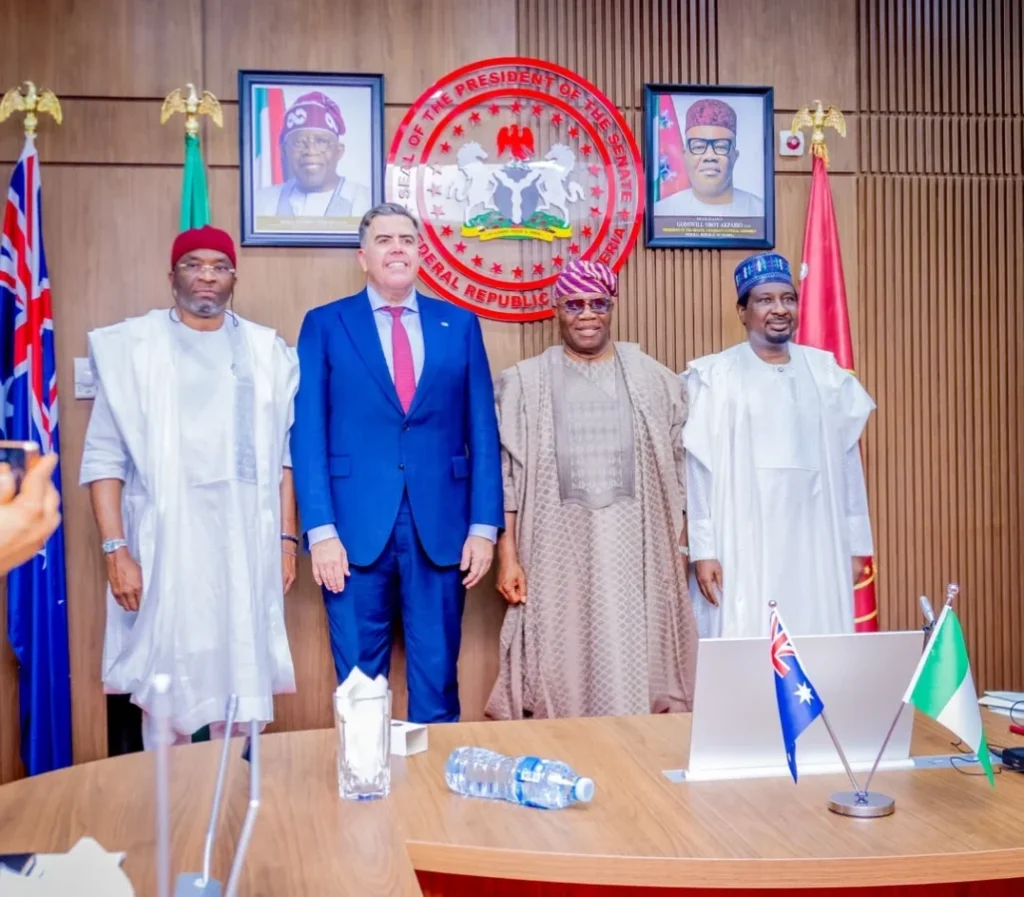
Akpabio pledges support for Milton Dick
During the meeting, Akpabio acknowledged Dick’s experience within the IPU.
Dick has served as Vice-President of the Asia-Pacific Geopolitical Group and has led several IPU delegations. Akpabio also referred to the Australian Speaker’s stated commitment to impartiality, inclusion and parliamentary diplomacy.
The Senate President said Nigeria would advocate for Dick’s candidacy during an upcoming meeting of the African Group.
The African parliamentary group was scheduled to meet on October 4, ahead of the IPU presidential election. Akpabio said he would participate in the meeting to present Dick’s candidature.
The position is a statement of Nigeria’s support. It does not determine how other African IPU members will vote.
IPU election scheduled for October 9
The IPU is scheduled to elect its 32nd President on October 9, 2026, during its 153rd Assembly in Arusha, Tanzania.
The organisation has listed three candidates for the 2026–2029 presidency.
They are Milton Dick of Australia, Sahiba Gafarova of Azerbaijan and Rojo Edwards Silva of Chile.
The elected president will serve a three-year term and must remain a sitting member of parliament throughout the mandate.
The IPU president serves as the organisation’s political head, chairs its statutory meetings and represents the union at major international events.
The election will take place as part of the 153rd IPU Assembly, which is scheduled for October 5 to 9 in Arusha.
Nigeria-Australia relations take centre stage
Beyond the IPU election, the discussions between Akpabio and Dick covered opportunities for stronger cooperation between Nigeria and Australia.
The two sides identified several areas for deeper engagement.
These include mining, agriculture, education, renewable energy, technology, security and institutional capacity building.
Akpabio also encouraged Australian businesses to explore investment opportunities in Nigeria.
He pointed to Nigeria’s large consumer market, youthful population and natural resources as areas that could support stronger commercial relations.
The Senate President said closer engagement could help establish a stronger parliamentary bridge between Africa and the Pacific region.
Dick seeks Nigeria’s support
Dick told Akpabio that he had been advised to visit Nigeria as part of his campaign for the IPU presidency.
He said Nigeria’s position in Africa made engagement with the country’s parliamentary leadership important to his campaign.
Dick expressed appreciation for the opportunity to present his candidature and seek Nigeria’s support.
He also commended Nigeria’s contribution to democracy and the work of the IPU.
The Australian Speaker said his relationship with Nigeria would continue regardless of the outcome of the election.
What the IPU presidency means
The IPU is the global organisation of national parliaments.
It currently comprises 183 national Member Parliaments and 15 regional parliamentary bodies, according to the organisation. Its work focuses on parliamentary cooperation, dialogue, peace, democracy and sustainable development.
The presidency therefore provides a platform for parliamentary diplomacy and representation at major international forums.
The incoming president will replace Tanzania’s Tulia Ackson, whose three-year term ends in October 2026.
The election will also take place against the background of wider discussions about the role of parliaments in international cooperation.
Nigeria’s role in the African parliamentary group
Akpabio’s pledge places Nigeria’s position within the broader African Group discussion ahead of the election.
The Senate President acknowledged that African members could have different positions.
However, he said he would present Dick’s candidature when the group meets.
This means Nigeria’s declared position is distinct from the collective position of the African Group, which had yet to be formally established at the time of the Abuja meeting.
The distinction is important because the IPU presidency will be decided through the organisation’s electoral process involving its member parliaments.
Parliamentary diplomacy between Nigeria and Australia
The Abuja meeting also highlighted the wider diplomatic value of parliamentary engagement.
Nigeria and Australia have different geographical and economic positions, but both operate federal political systems.
Akpabio has argued that the two countries can use parliamentary engagement to strengthen cooperation in areas of mutual interest.
Mining and steel development featured prominently in subsequent discussions involving the Australian delegation. Akpabio said Nigeria could learn from Australia’s experience in those sectors.
For Nigeria, the engagement also provides an opportunity to attract Australian investment and deepen institutional exchanges.
For Australia, stronger engagement with Nigeria offers access to one of Africa’s largest markets and an important parliamentary partner.
Election will determine next IPU president
With the IPU election scheduled for October 9, attention will now turn to the campaigns and positions of the three candidates.
Nigeria has publicly declared its support for Milton Dick.
The other candidates are Sahiba Gafarova of Azerbaijan and Rojo Edwards Silva of Chile. The IPU has published background information on all three candidates ahead of the election.
The eventual outcome will be determined through the IPU’s established electoral process at the 153rd Assembly in Tanzania.
For Nigeria, the episode has combined international parliamentary diplomacy with an effort to deepen bilateral economic and institutional relations with Australia