
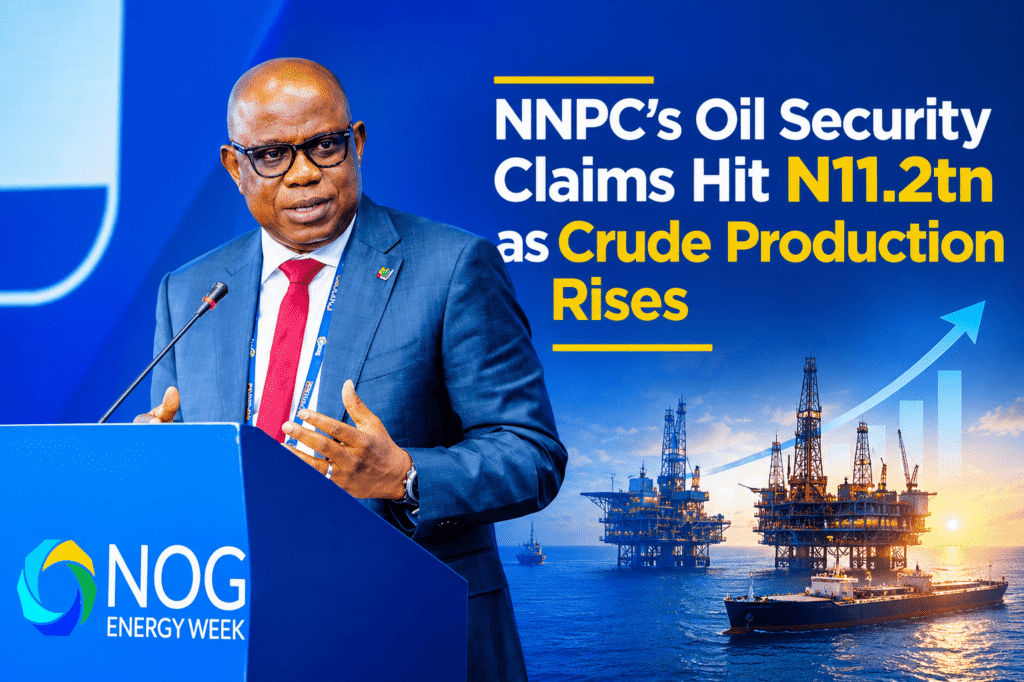

The Nigerian National Petroleum Company Limited (NNPC) has recorded ₦11.2 trillion in claims against the Federation for costs and advances incurred on behalf of the government.
The figure includes costs linked to protecting Nigeria’s oil and gas assets from crude oil theft, pipeline vandalism and other security threats.
An analysis of NNPC’s 2025 audited financial statements shows that the claims increased by ₦4.07 trillion, or about 57 per cent, from the ₦7.13 trillion energy security expense reported in 2024.
However, the ₦11.2 trillion figure requires careful interpretation.
It does not represent ₦11.2 trillion in fresh energy-security expenditure incurred by NNPC during 2025.
Instead, the amount combines energy-security-related receivables with other advances and receivables owed by the Federation.
NNPC’s energy security receivables reach ₦8.67tn
According to the company’s financial statements, NNPC’s energy security cost receivable stood at ₦8.67 trillion at the end of 2025.
Other receivables from the Federation, including advances and security-related costs, brought the total to ₦11.2 trillion.
The arrangement operates under an approved framework between the Federal Government and NNPC.
Under the arrangement, NNPC incurs certain costs associated with protecting the country’s oil and gas infrastructure. The company subsequently charges those costs to the Federation.
These activities are linked to efforts to protect critical petroleum infrastructure from theft, vandalism and other disruptions.
The scale of the receivables highlights the financial implications of maintaining security around Nigeria’s oil-producing and evacuation infrastructure.
No new energy security expense recognised in 2025
One of the most important details in the audited accounts is that NNPC did not recognise a new energy security expense in 2025.
That compares with ₦7.13 trillion recognised in 2024.
NNPC said outstanding energy security costs were reconciled against royalties, taxes and dividends owed by the government as of December 2024.
The reconciliation exercise was completed in September 2025.
Therefore, describing the entire ₦11.2 trillion as money newly spent on oil security in 2025 would be misleading.
The figure is better understood as a combination of outstanding energy-security-related receivables and other amounts due from the Federation.
Oil security costs remain linked to crude theft
Nigeria has historically faced significant losses from crude oil theft, pipeline vandalism and illegal connections.
These activities have affected production and the ability of operators to move crude from producing fields to export terminals.
The security challenge has also created additional costs for protecting pipelines, oil facilities and other critical infrastructure.
NNPC’s latest financial disclosure comes as the company reports an improvement in crude production.
The company said average crude oil and condensate production reached 1.77 million barrels per day in 2025, its highest level in five years.
Total crude oil and condensate production reached 565.8 million barrels during the year, representing a five per cent increase.
NNPC’s equity share also increased by 11 per cent to 223.7 million barrels.
Ojulari cites improved pipeline security
NNPC Group Chief Executive Officer, Bayo Ojulari, attributed part of the production improvement to stronger security around major crude evacuation pipelines.
According to Ojulari, community-based surveillance, government intervention and security agencies have contributed to improved pipeline availability.
He said major pipelines had recorded improved stability, although crude theft remained a challenge around smaller pipelines and wellheads in difficult-to-access areas.
The company is also deploying technology to strengthen infrastructure protection.
Ojulari said NNPC is installing technology-enabled wellhead cages and using fibre-optic and intruder-detection systems on some pipelines.
The objective is to detect unauthorised access and respond more quickly to threats.
Higher security costs coincide with higher oil output
The latest figures present an important contrast in Nigeria’s petroleum sector.
On one hand, the country continues to carry substantial costs associated with protecting its oil and gas infrastructure.
On the other, improved security and pipeline availability have coincided with higher crude production.
The relationship is significant because higher oil output can improve government revenues, exports and foreign-exchange earnings.
However, the financial burden of securing oil assets remains an important cost within the sector.
The challenge is therefore not only to increase production but also to ensure that the additional output is economically sustainable.
NNPC profit rises to ₦7.2tn
The disclosure on oil security claims came alongside stronger financial results from NNPC.
The company reported ₦7.2 trillion profit after tax for 2025, compared with ₦5.4 trillion in 2024.
That represents an increase of about 33 per cent.
NNPC also reported revenue of ₦34.5 trillion, while earnings before interest, taxes, depreciation and amortisation rose 22 per cent to ₦18 trillion.
Operating cash flow increased 16 per cent to ₦12.8 trillion. The company declared a dividend of ₦5.8 trillion.
The improved financial performance came as oil and gas production increased and several infrastructure projects advanced.
What the ₦11.2tn claim means for Nigeria
The size of NNPC’s receivables from the Federation raises broader questions about how petroleum-sector costs are managed.
Oil security is necessary for protecting production and national energy infrastructure.
At the same time, the scale of the claims shows how expensive it can be to maintain security across a large and geographically dispersed petroleum network.
The government’s ability to reconcile and settle such obligations also matters for NNPC’s financial position and the wider Federation account.
However, the latest accounts do not support treating the ₦11.2 trillion as a single-year cash bill.
The distinction between receivables, outstanding costs and fresh expenditure is critical when assessing the company’s financial position.
Production targets remain ambitious
NNPC is targeting further growth in oil and gas production.
The company aims to increase crude oil production to two million barrels per day by 2027 and three million barrels per day by 2030.
It is also targeting gas production of 12 billion standard cubic feet per day by 2030.
NNPC has said it plans to mobilise about $60 billion in upstream, midstream and downstream investments over the period.
Achieving those targets will depend on several factors, including continued improvements in security, investment in infrastructure and sustained production from existing and new assets.
The bigger oil-sector challenge
The latest financial disclosure shows that Nigeria’s oil-sector recovery involves more than increasing crude production.
The country must also protect pipelines, reduce theft, maintain infrastructure and ensure that petroleum-sector costs are properly accounted for.
NNPC’s ₦11.2 trillion Federation receivables therefore provide a window into the financial scale of those obligations.
At the same time, the company’s higher production and profit figures indicate that improvements in security and operational performance can have measurable financial effects.
The key issue going forward will be whether Nigeria can sustain higher production while reducing the operational and financial burden associated with protecting its petroleum infrastructure.