
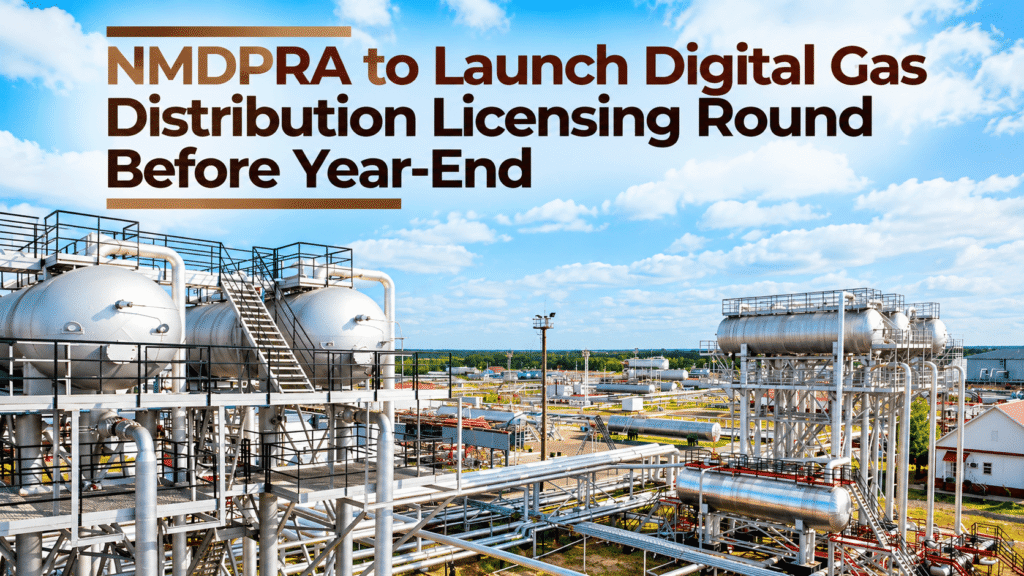

Nigeria’s gas sector is set for another major regulatory development as the Nigerian Midstream and Downstream Petroleum Regulatory Authority (NMDPRA) plans to launch a digital gas distribution licensing round before the end of 2026.
The proposed exercise will allow investors to bid for designated gas distribution areas across the country.
NMDPRA Chief Executive, Rabiu Umar, disclosed the plan during the Gas Investment Forum 2026, themed “Positioning Nigeria as Africa’s Global Gas Powerhouse.”
According to Umar, the licensing round will follow a nationwide gas distribution gridding exercise expected to be completed in October.
The initiative is designed to expand gas distribution infrastructure and move the sector towards a more open-access system.
NMDPRA to Map Gas Distribution Areas
Under the planned framework, Nigeria will be divided into designated gas distribution areas through the ongoing nationwide gridding exercise.
Investors will then be able to bid for licences covering available areas.
Umar compared the proposed process with the way Oil Mining Licences are awarded in the upstream petroleum sector.
“Under the licensing round, applicants will bid for gas distribution licences in the gridded areas available across the country,” he said.
The approach could provide investors with clearer geographical opportunities while giving the regulator a more structured way to manage gas distribution infrastructure.
However, NMDPRA has not yet published the complete list of areas, bidding requirements, timelines or commercial terms for the new round.
Those details are expected to become clearer after the gridding exercise and formal launch of the licensing process.
Open Access at the Centre of the New Gas Framework
The planned licensing round is part of NMDPRA’s broader effort to improve access to gas infrastructure.
Umar said Nigeria needs to move away from a fragmented infrastructure and access system towards a genuine open-access regime.
Under such a framework, gas infrastructure would be available to qualified market participants under clearly defined rules and commercial arrangements.
This is particularly important because Nigeria has substantial gas resources but continues to face infrastructure constraints.
The NMDPRA chief said gas infrastructure must enable the movement of gas from wellheads to processing facilities, pipelines, power plants, industrial clusters, transport corridors, homes and export terminals.
Nigeria Already Has Gas Distribution Licence Holders
The planned licensing round is not the first attempt by NMDPRA to establish dedicated gas distribution zones.
In January 2025, the regulator awarded 10 Gas Distribution Licences to six companies.
The beneficiaries included NNPC Gas Marketing Limited, Shell Nigeria Gas Limited, NIPCO, Central Horizon Gas Company, Falcon Corporation and AXXELA.
The Gas Distribution Licence provides qualified operators with rights to establish, construct and operate gas distribution systems within designated Gas Distribution Zones under the Petroleum Industry Act.
NMDPRA’s latest plans therefore represent another phase in the development of the country’s gas distribution network.
The regulator has also indicated that existing licensed zones have begun supporting customers and pipeline infrastructure.
In a recent industry engagement, NMDPRA said the 10 licences issued in 2025 covered networks serving about 430 customers, with more than 535 kilometres of pipeline infrastructure and combined network capacity of about 442 million standard cubic feet per day.
Gas Supply Is Growing, But Distribution Remains a Challenge
The licensing initiative comes as Nigeria’s domestic gas supply continues to increase.
The country’s domestic gas supply recently crossed 2 billion cubic feet per day, according to the Federal Government.
Minister of State for Petroleum Resources (Gas), Ekperikpe Ekpo, said total gas production had risen to about 7.5 billion cubic feet per day, compared with roughly 6.8 billion cubic feet per day in 2023.
Nigeria’s proven gas reserves have also increased to about 215.19 trillion cubic feet.
The government is targeting gas production of 10 billion cubic feet per day by 2027 and 12 billion cubic feet per day by 2030.
The figures highlight an important issue for the industry.
Increasing production does not automatically guarantee that gas reaches consumers.
Nigeria’s upstream regulator reported average domestic gas delivery of 2.05 billion cubic feet per day in the first half of 2026, against a Domestic Gas Delivery Obligation allocation of 3.16 billion cubic feet per day. That represented about 65 percent performance.
Consequently, expanding distribution infrastructure could become increasingly important as domestic demand grows.
NMDPRA Seeks Investment in Gas Infrastructure
Umar said Nigeria must transform its gas reserves into infrastructure that can support economic activity.
He warned that gas reserves without adequate infrastructure would remain largely potential rather than becoming productive assets.
The regulator is therefore accelerating approvals and licences covering different areas of the gas value chain.
These include gas processing plants, pipelines, storage facilities, compressed natural gas and liquefied natural gas projects.
The strategy also comes against the backdrop of major pipeline projects.
The Federal Government said the Obiafu-Obrikom-Oben (OB3) pipeline has reached completion and is being prepared for first gas.
The pipeline has a capacity of about 2 billion cubic feet per day and is expected to unlock more than 500 million standard cubic feet per day of additional gas for the domestic market.
Meanwhile, the Ajaokuta-Kaduna-Kano (AKK) pipeline was reported to be about 95 percent complete.
Competition and Infrastructure Access
Another major issue raised by NMDPRA is competition within the gas infrastructure market.
Umar said the authority has established a cooperation framework with the Federal Competition and Consumer Protection Commission to address anti-competitive practices.
The framework is expected to address issues such as price fixing, market sharing, abuse of dominance, capacity hoarding and discriminatory access.
At the same time, NMDPRA said infrastructure owners would not be forced to surrender capacity that is already fully utilised.
This balance could become increasingly important as more companies enter gas distribution.
Investors require confidence that they can access infrastructure and compete under predictable rules.
Infrastructure owners, meanwhile, need commercial certainty to justify investment in pipelines and distribution systems.
NMDPRA Pushes Towards a More Mature Gas Market
The planned licensing round also fits into NMDPRA’s broader efforts to develop a more commercially driven domestic gas market.
Umar has said the regulator is working towards measurable conditions for a transition to a willing-buyer, willing-seller gas market.
Among the issues being considered are supply diversity, infrastructure access, contract performance, payment discipline, reliable market data and credible pricing.
The regulator has also previously indicated that it intends to transition the domestic gas market towards greater price liberalisation, with a 2028 target for ending domestic gas price regulation.
For investors, the development of distribution zones, infrastructure access and clearer market rules could therefore be as important as the availability of gas itself.
What the Licensing Round Could Mean for Nigeria
If successfully implemented, the new gas distribution licensing round could attract additional private capital into Nigeria’s midstream and downstream gas infrastructure.
It could also encourage the development of industrial clusters around reliable gas supply.
For manufacturers, gas-based industries, power producers, CNG operators and commercial users, improved distribution could reduce some of the infrastructure constraints that have historically limited access to natural gas.
The opportunity is particularly significant as Nigeria seeks to expand domestic gas consumption while increasing production.
Still, the licensing exercise alone will not resolve all of the industry’s challenges.
Gas availability, pipeline construction, financing, tariffs, contract enforcement, payment discipline and infrastructure maintenance will all influence whether licensed distribution areas become commercially viable.
For now, the NMDPRA’s planned digital licensing round represents another step in Nigeria’s attempt to convert its large gas resource base into a wider network of infrastructure and domestic economic activity.
The next major milestone will be the completion of the nationwide gas-grid mapping exercise and the publication of the areas and terms that investors will be able to bid for.