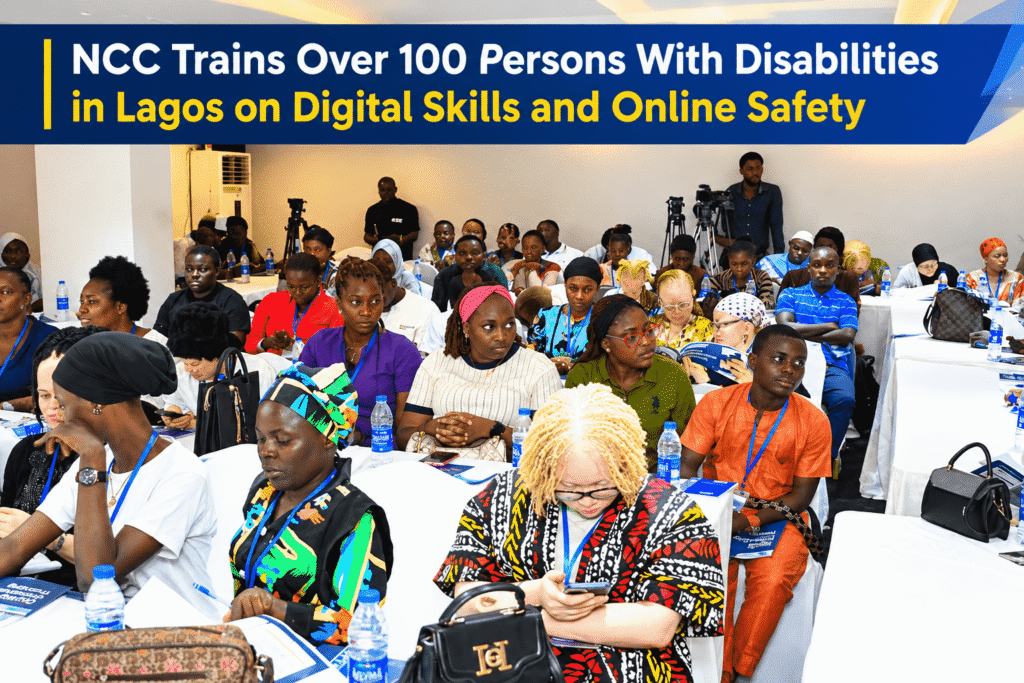

Having access to the internet is one thing, but knowing how to navigate it safely, productively, and independently is another entirely. Addressing that exact gap, the Nigerian Communications Commission (NCC) recently gathered over 100 Persons with Disabilities (PWDs) in Lagos State for an intensive two-day workshop focused on practical digital skills, cybersecurity, and adaptive technologies.
Held from September 9 to 10, 2026, the Digital Citizenship Training for Persons with Disabilities was organized under the theme, “Empowering Persons with Disabilities Through Digital Citizenship for an Inclusive Digital Economy.” The event marks the latest regional leg of a broader national rollout designed by the NCC to expand digital inclusion across all six of Nigeria’s geopolitical zones.
Moving Past Basic Internet Access
For many participants, the training moved quickly past abstract concepts into immediate daily applications. Rather than focusing solely on getting devices into hands, the curriculum prioritized the practical knowledge required to use digital technology productively and safely.
Attendees learned how to protect personal information, spot potential online scams, and exercise greater caution when interacting with unfamiliar individuals online. The sessions also emphasized practical accessibility solutions, introducing speech-to-text tools and screen readers that make everyday mobile devices significantly easier to use.
“Digital inclusion shouldn’t stop at providing a connection,” noted NCC Executive Vice-Chairman and Chief Executive Officer, Dr. Aminu Maida, whose remarks were delivered by Helen Obi, Director of Digital Economy. Maida stressed that true inclusion means giving Persons with Disabilities the skills and confidence required to participate safely and meaningfully in Nigeria’s expanding digital economy—a distinction that grows more critical as everyday banking, business, and education move online.
Collaborative Local Impact
The training was organized through close collaboration with the Lagos State Office for Disability Affairs (LASODA) alongside other key community partners.
Dr. Funmi Adekola, Head of Monitoring, Evaluation, and Orientation at LASODA—representing General Manager Mrs. Adenike Oyetunde-Lawal—commended the NCC for intentionally including PWDs in its digital empowerment initiatives. The event also brought together representatives from the Lagos State Ministry of Innovation, Science and Technology and the Christian Blind Mission, highlighting how federal digital strategy relies on state agencies to deliver meaningful local impact.
Linking Digital Literacy to Economic Opportunity
Beyond online safety, the program directly connected digital literacy with broader socio-economic participation. Today, digital platforms serve as primary gateways for employment searches, entrepreneurship, and business promotion. For Persons with Disabilities, mastering these platforms helps lower traditional physical barriers to economic independence.
However, organizers acknowledged that training is only one piece of the puzzle. Realizing sustained participation will also require ongoing access to affordable internet, suitable hardware, accessible digital platforms, and continuous skill development.
A Piece of a Broader Accessibility Strategy
This Lagos workshop builds on a long line of NCC digital accessibility initiatives aimed at closing the technology gap:
-
The E-Accessibility Project: An ongoing nationwide effort distributing specialized ICT tools, assistive technologies, training, and internet access to facilities supporting people with special needs.
-
Targeted Innovation Hackathons: The Commission’s 4th Hackathon, themed “Technology Without Barriers,” awarded top honors to SORA, an adaptive job-matching and skills platform built specifically for verified PWDs in Nigeria. Other winning solutions included accessible power outage alerts and AI-driven voice-dictation tools.
-
Assistive Tech R&D: Direct support for assistive hardware prototypes, including smart walking sticks designed for blind and visually impaired individuals.
From Workshop to Everyday Participation
The conclusion of the Lagos program represents another concrete step in the NCC’s digital inclusion strategy. While more than 100 participants walked away with immediate, practical knowledge, the long-term impact will depend on how seamlessly these skills translate into education, employment, and everyday communication.
By grounding its strategy in cybersecurity, digital citizenship, and accessible tech, the NCC is ensuring that as Nigeria’s digital economy grows, Persons with Disabilities have a secure, equal seat at the table.