
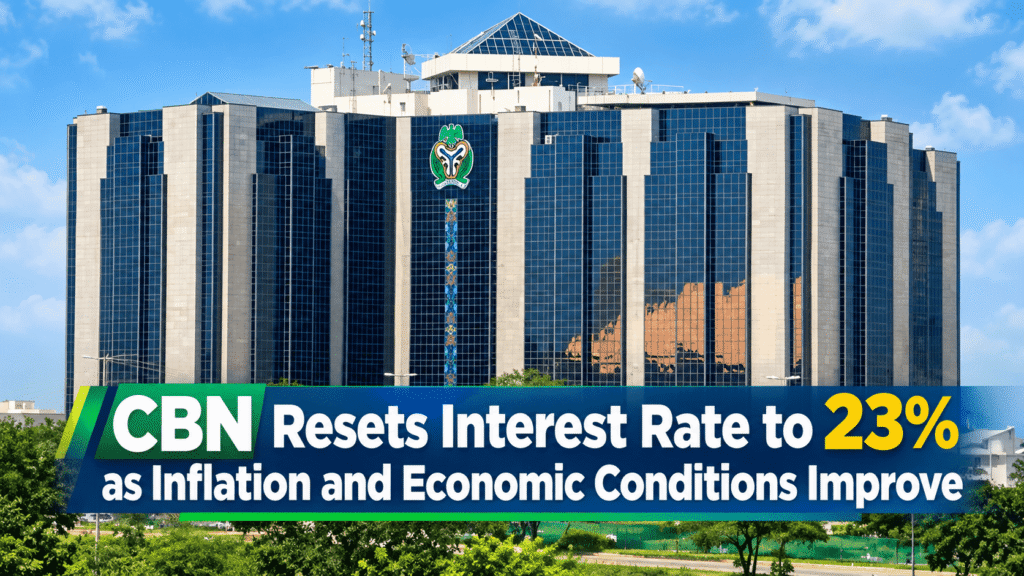

The Central Bank of Nigeria (CBN) has adjusted its benchmark interest rate, slashing the Monetary Policy Rate (MPR) by 350 basis points from 26.5 percent to 23 percent.
The move, announced by CBN Governor Olayemi Cardoso at the conclusion of the Monetary Policy Committee’s (MPC) 307th meeting in Abuja, marks the bank’s first major policy shift since February. Rates had remained held at 26.5 percent across both the May and July meetings.
However, Cardoso cautioned against misreading the substantial cut as a sudden pivot toward aggressive monetary easing. Instead, the central bank is framing the decision as an “operational reset”—a structural recalibration designed to align the benchmark rate with actual money-market conditions and fix policy transmission loopholes.
A Technical Shift to Fix Policy Transmission
Underneath the headline reduction, the MPC made several key adjustments to its operational corridor:
-
Standing Facilities Corridor: Recalibrated to +50 and -300 basis points around the new 23 percent policy rate.
-
Cash Reserve Requirement (CRR): Retained at 45 percent for deposit money banks and 16 percent for merchant banks.
-
Public Sector CRR: Held firm at 75 percent for non-Treasury Single Account (TSA) public-sector deposits.
According to the central bank, a growing disconnect had emerged between the old 26.5 percent benchmark rate and actual transaction yields in the interbank market, blunting the MPR’s effectiveness as a signal.
By anchoring its operational framework around the Nigerian Overnight Financial Average (NOFA)—a transaction-based benchmark—the CBN aims to restore transparency and ensure its rate signals actually move the broader financial system.
Macroeconomic Tailwinds Give Room to Maneuver
The MPC’s decision follows several consecutive months of improving macroeconomic metrics:
-
Easing Inflation: Headline inflation cooled slightly to 15.39 percent in August (down from 15.43 percent in July), while food inflation dropped from 20.31 percent to 19.57 percent. On a month-on-month basis, headline price growth slowed sharply from 1.57 percent to 0.71 percent.
-
Foreign Reserves Buildup: Gross external reserves reached $55.25 billion as of September 18, supported by a widening balance-of-payments surplus that hit $3.51 billion in Q2 (up from $2.38 billion in Q1).
-
Accelerating Growth: Nigeria’s real Gross Domestic Product (GDP) grew by 4.43 percent year-on-year in Q2 2026, outperforming the 3.89 percent recorded in Q1. Non-oil sectors expanded by 4.31 percent, while oil sector GDP surged 7.31 percent.
-
Business Activity: The Composite Purchasing Managers’ Index (PMI) rose to 52.7 points in August from 51.1 in July, signaling steady expansion across commercial sectors.
What the Rate Cut Means for Business Borrowers and Investors
For Nigeria’s private sector, the 350-basis-point cut offers a glimmer of hope for cheaper credit. Business advocacy groups have long pointed to elevated borrowing costs as a primary bottleneck for manufacturing, retail, and small business expansion.
However, whether commercial banks actually pass on lower interest rates to business borrowers remains to be seen. Commercial lending rates tend to lag benchmark cuts, depending heavily on individual bank liquidity and risk assessments.
In the fixed-income market, yields had already begun trending downward ahead of the meeting. The lower policy rate is expected to keep yields under downward pressure as institutional investors reprice treasury bills and bonds. Nevertheless, real returns will remain tied to broader liquidity flows, government borrowing needs, and inflation trajectories.
Election Cycle Risks and Liquidity Oversite
Despite the rate reduction, the CBN stressed that it is keeping a firm hand on liquidity. With Nigeria’s next election cycle approaching, central banks historically face heightened money supply pressures and increased foreign exchange demand.
Cardoso noted that the CBN has modeled liquidity scenarios based on historical election cycles and stands ready to mop up excess cash in the banking system using open market operations if inflationary pressures resurface.
Looking Ahead
This operational reset marks a pivotal moment in the CBN’s monetary strategy after months of tight policy holds. The committee indicated that future rate decisions will remain strictly data-dependent, with close attention paid to exchange rate stability, inflation trajectories, and liquidity levels.
The MPC is scheduled to reconvene for its final meeting of the year on November 23 and 24, 2026. In the interim, market watchers will be evaluating how quickly commercial banks adjust their prime lending rates—and whether the reset delivers real relief to the broader economy.